


After analyzing chemical composition, hardness, toughness and internal controls, we now…
Radioactivity control in steels: procedures and equipment in steel mills
In the modern steel industry, steel quality does not depend only on chemical composition, mechanical properties or microstructure.
There is a fundamental control, often less known but essential for the safety of the entire production process: radioactivity control in steels.
This control is mainly applied in steel mills that use ferrous scrap as raw material, with the aim of preventing the accidental entry of materials contaminated by radioactive sources.
👉 Radiometric control is essential to ensure:
- production process safety
- worker protection
- environmental protection
- regulatory compliance
- quality of the material produced
For this reason, steel mills adopt radiometric monitoring systems along different stages of the production cycle, with particular attention to the scrap entry phase.
🔍 Why control radioactivity in steels
The presence of radioactive sources in scrap can come from materials or equipment originating from different sectors.
Possible sources include:
- decommissioned industrial equipment
- medical instruments
- measuring devices
- materials from sectors that use radioactive isotopes
If these materials accidentally entered the steelmaking cycle and were melted in furnaces, they could contaminate:
- the steel batch produced
- slag
- fume abatement systems
- production areas
- equipment
👉 The consequences could be serious from both a health and environmental point of view and a production point of view.
For this reason, radioactivity control is an essential preventive measure.
🧪 What radiometric control is
Radiometric control is a monitoring procedure used to detect any abnormal radioactivity levels in metallic materials.
In the steelmaking process, it is mainly applied to the control of ferrous scrap before it is accepted into the plant and introduced into the production cycle.
👉 The aim is to intercept any radioactive sources before they can reach the melting furnace.
This control is not intended to modify the material, but to verify that the incoming material does not show radiological anomalies.
It is therefore a form of preventive control, linked to process safety and supply chain quality.
🚛 Radiometric control at scrap entry
The first and most important level of control is carried out at the plant entrance.
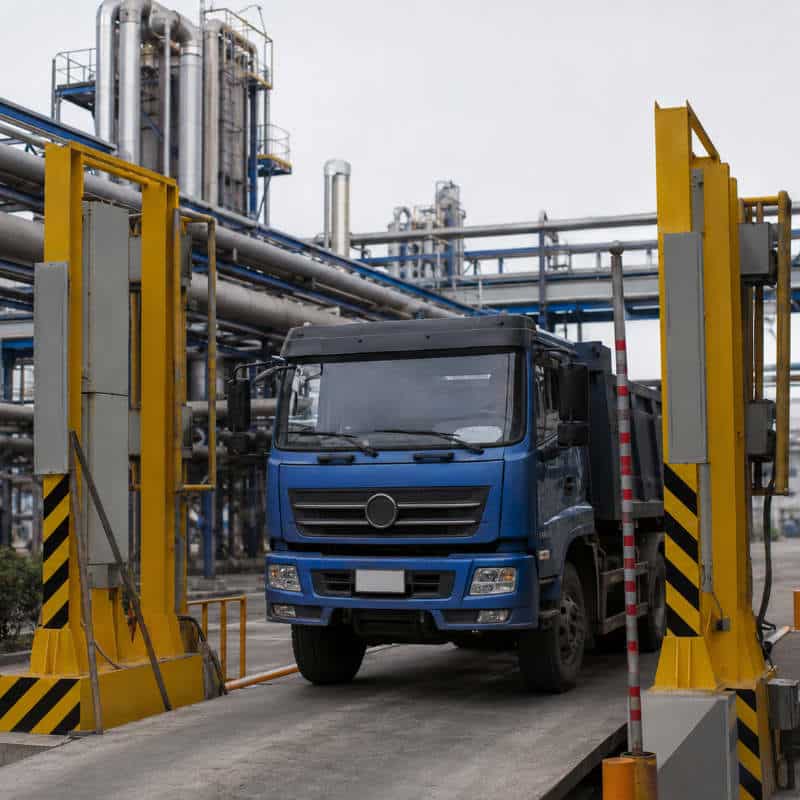
Trucks or railway wagons transporting ferrous scrap pass through dedicated radiometric detection portals installed at the entrance to the facility.
👉 During vehicle transit:
- detectors measure the radiation level emitted by the transported material
- the value is compared with the natural background level of environmental radiation
- the system checks whether the levels fall within the required thresholds
- if the threshold is exceeded, an alarm is triggered
When an anomaly occurs, the load is isolated for further checks and is not directly accepted into the production cycle.
🧰 The radiometric portal
The radiometric portal is one of the main instruments used for radioactivity control in steel mills.
It generally consists of:
- radiation sensors positioned on the sides of the vehicle passage
- signal processing units
- visual and acoustic alarm systems
- measurement recording and traceability software
👉 Its task is to quickly check incoming vehicles, detecting any radiometric anomalies before the material is unloaded or sent to production.
This type of system makes it possible to monitor large quantities of scrap continuously and non-invasively.
🔦 Portable instrumentation for radioactivity control
In addition to radiometric portals, steel mills can use portable instruments for more detailed checks.
These instruments are mainly used when a load is considered suspicious or when a specific area of the material needs to be verified.
Geiger-Müller counters
Portable Geiger-Müller counters are used to perform localized checks.
👉 They allow operators to:
- verify the point from which the anomaly originates
- check specific portions of the load
- identify any radioactive sources
- support operational management in the event of an alarm
They are useful tools for moving from a general control to a more targeted verification.
Portable gamma spectrometers
When it is necessary to identify the type of contamination more precisely, portable gamma spectrometers can be used.
These instruments analyze the energy spectrum of the emitted radiation and make it possible to identify any radionuclides present in the material.
Among the isotopes that can be detected in cases of accidental contamination are, for example:
- Cesium-137
- Cobalt-60
- Iridium-192
👉 Isotope identification is important because it allows the nature of the contamination and the subsequent material management procedures to be correctly defined.
⚠️ Procedures in case of radioactivity detection
When a radiometric monitoring system detects radiation levels above the established thresholds, specific operating procedures are activated.
In general, the process may include:
- immediate blocking of the incoming vehicle
- isolation of the load in a dedicated safety area
- verification of the measurement using portable instruments
- identification of the possible radioactive source
- communication to the competent authorities
- controlled management of the material
👉 Only after all radiometric checks have been completed and the presence of contamination has been excluded can the material be accepted into the production cycle.
This step is essential to prevent an anomaly from turning into a safety, production and quality issue.
🧾 Regulations and safety requirements
Radioactivity control in steel plants is regulated by national and international standards.
In Europe, the provisions derive from regulations on protection against ionizing radiation and from Euratom directives, implemented in national legislation.
👉 Steel mills must therefore be equipped with:
- radiometric detection systems
- emergency procedures
- adequately trained personnel
- recording and traceability systems
- methods for managing any radiological anomalies
Radiometric control is therefore also a safety and responsibility requirement along the production chain.
🏭 Radioactivity control in the BA context
In the Bonomi Acciai context, radioactivity control in steels can be described as an integral part of the safety and quality of the special steel supply chain.
This control is mainly carried out by the producing steel mills, especially during the ferrous scrap acceptance phase, before the material is introduced into the melting cycle. This is a fundamental preventive step, because it makes it possible to verify that the incoming scrap does not show radiometric anomalies.
👉 For Bonomi Acciai, the value of this control is linked to the possibility of supplying steels from a qualified supply chain, subject to multiple quality checks, including the guarantee that the material is free from radioactivity.
From an instrumentation point of view, it is correct to refer mainly to the radiometric portals used in steel mills to check incoming vehicles. If needed or for targeted verification, portable instruments such as Geiger-Müller counters can also be used.
In the event of a radiometric alarm, the procedure generally involves the immediate blocking of the load, the interruption of unloading or handling operations, the isolation of the area and the instrumental verification of the material by authorized personnel.
During this phase, the area is cordoned off and access is limited to authorized and trained personnel only. The checks are carried out by applying the basic principles of radiation protection: reducing exposure time, maintaining a safe distance and using shielding when available.
👉 The aim is to avoid unnecessary exposure, prevent the dispersion of any contaminated material and ensure the safety of the production process.
For the customer, radiometric control therefore represents a complete guarantee: it protects safety, ensures compliance with regulations, guarantees traceability and safeguards both the production process and the final quality of the material.
For this reason, in the BA context it makes sense to describe radioactivity control not as an isolated control, but as one of the elements of the quality supply chain of the steels supplied: a preventive verification that contributes to the safety, reliability and conformity of the final product.
🔄 Link to the series
In the series dedicated to steel quality, radioactivity control represents a different type of verification compared with chemical composition, hardness, resilience or metallography.
It does not directly describe the mechanical properties of the material, but protects the safety of the production process.
👉 It is a preventive control, designed to prevent contaminated materials from entering the steelmaking cycle.
For this reason, radiometric control can be considered one of the foundations of quality: even before analyzing the performance of steel, it is necessary to ensure that the production process is safe and controlled.
🎯 Conclusion
Radioactivity control in steels is a fundamental measure for ensuring the safety of the steelmaking process.
Through radiometric portals, portable instruments and dedicated operating procedures, steel mills can promptly identify any radioactive contamination present in ferrous scrap.
👉 This control makes it possible to protect workers, plants, the environment and the quality of the material produced.
Understanding radioactivity control means understanding that steel quality does not arise only from its chemical, mechanical and metallurgical characteristics, but also from the safety of the entire production process.
I am text block. Click edit button to change this text. Lorem ipsum dolor sit amet, consectetur adipiscing elit. Ut elit tellus, luctus nec ullamcorper mattis, pulvinar dapibus leo.


